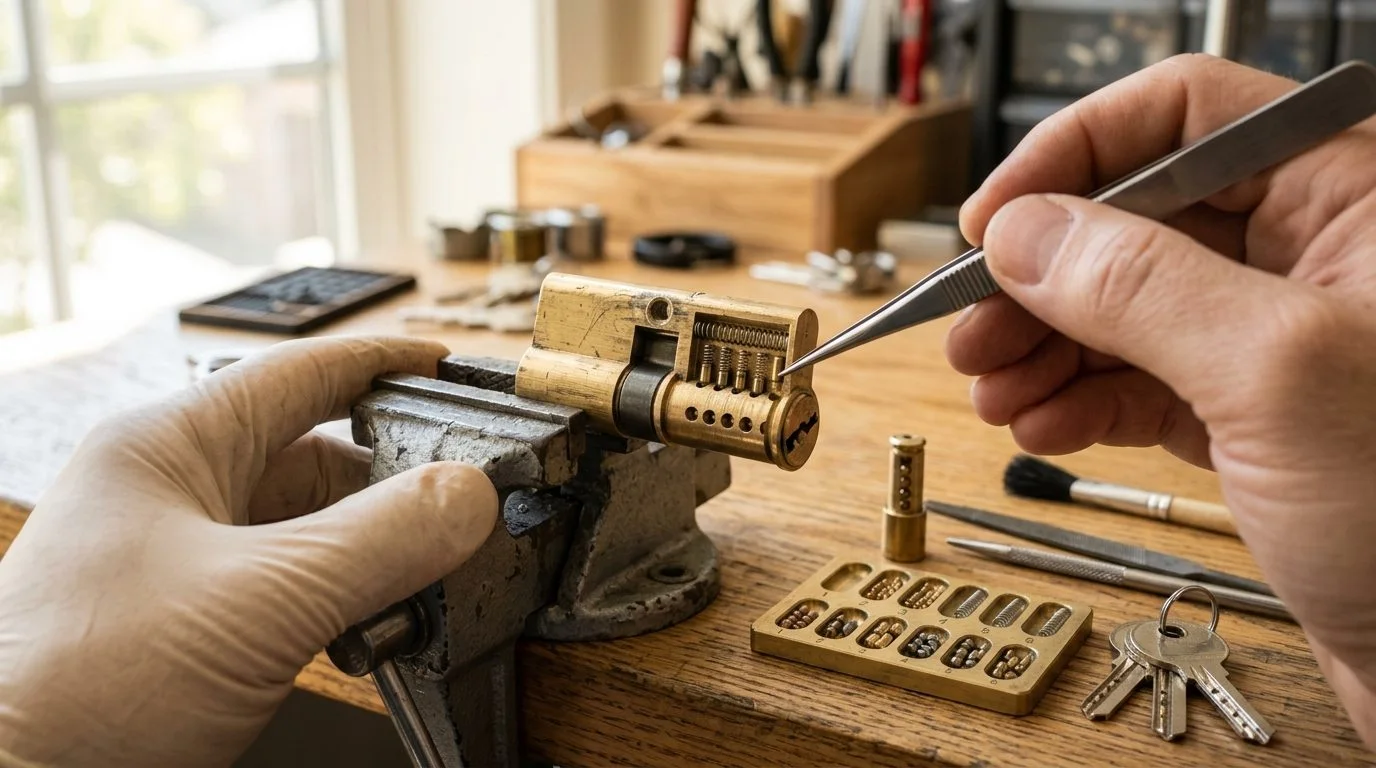
What does rekeying a lock actually mean?
Rekeying means resetting the inside of a lock so it accepts a different key, without removing the lock hardware from your door. The body of the lock, the deadbolt, the strike plate, and the finish on your door all stay exactly as they are. What changes is the hidden mechanism that decides which key turns the cylinder.
Most residential locks are pin tumbler locks. Inside the cylinder is a row of small chambers, each holding a pair of stacked pins: a 'key pin' that touches the key and a 'driver pin' above it. When you insert the correct key, the cuts on the key push each pin pair to a precise height so the gap between them lines up at the 'shear line.' At that point the cylinder is free to rotate and the lock opens.
To rekey, a locksmith replaces the key pins with a new set of different lengths chosen to match a new key. After the swap, only the new key raises the pins to the shear line, and any previously working key no longer fits the pattern. This is why rekeying is the usual answer when you need old keys to stop working but the lock itself is still in good shape.
How does the rekeying process work step by step?
The work is methodical rather than forceful, and a trained locksmith follows the same general sequence on most standard residential locks. Here is what a typical rekey involves so you know what to expect when you have one done.
- Confirm the lock is a good candidate: the cylinder turns smoothly and the hardware is not cracked, badly worn, or corroded.
- Remove the lock cylinder from the door (for a deadbolt or knob, this usually means taking off the interior hardware and sliding the cylinder out).
- Open up the cylinder with the appropriate tools so the existing pins can be reached safely.
- Take out the old key pins and select new key pins in the lengths that correspond to a fresh key code.
- Insert the new pins, reassemble the cylinder, and reinstall it in the door.
- Test the new key several times, locking and unlocking, and confirm the old key no longer works.
Rekeying vs. replacing a lock: which do you need?
Rekeying and replacing solve different problems, even though both end with you holding a working key that others do not have. Rekeying keeps your existing lock and changes which key operates it. Replacing removes the old lock entirely and installs new hardware. The right choice usually comes down to the condition of the lock and what you want to change.
Rekeying tends to make sense when the lock is in good working order and you simply want to control who has a key, such as after closing on a home, after a roommate moves out, or after a key goes missing. Replacement tends to make sense when the lock is damaged, heavily worn, outdated, or when you want a different style, a higher grade of security, or a new feature like a smart lock or a keypad.
There is also a middle path many homeowners like: keying multiple locks to a single key. If you have several doors with compatible cylinders, a locksmith can rekey them so one key opens all of them, which reduces the keys on your ring without buying matched hardware. Any prices you see for either option should be treated as typical industry ranges rather than a quote, and the most accurate way to learn your cost is to request a quote based on your specific locks and door count.
When should you rekey your locks?
Certain life events are natural triggers for rekeying because they change who legitimately holds a key. Thinking through these moments helps you decide whether a quick rekey is worth scheduling.
If you are unsure whether your situation calls for rekeying or full replacement, describing it to a locksmith is the fastest way to get a clear recommendation rather than guessing.
- You just moved into a new home or apartment and do not know how many copies of the old keys exist.
- A key was lost or stolen and you want any copy of it to stop working.
- A tenant, roommate, contractor, former partner, or former employee no longer needs access.
- You want several doors to open with one key for convenience.
- You have collected mismatched keys over the years and want to simplify back to a single key.
- You want a fresh start on access after any situation where you are not certain who could have a working key.
What kinds of locks can be rekeyed?
Many common locks built around a pin tumbler cylinder can be rekeyed, which covers a large share of the deadbolts, entry knobs, and levers found on homes and small businesses. Padlocks with removable cylinders and many file cabinet and mailbox locks can also be rekeyed depending on their design.
Some locks are not practical to rekey. Hardware that is cracked, seized, or badly corroded is usually better replaced because the underlying mechanism is already failing. Certain high-security and proprietary cylinders use restricted keyways and patented keys, which means they can often be rekeyed only with the maker's authorized parts and key blanks, so it is worth mentioning the brand when you call.
Electronic and smart locks change the picture entirely. Many smart locks store access as codes, fobs, or app permissions rather than relying solely on a metal key, so 'rekeying' them can mean deleting old codes and credentials instead of swapping pins. A number of smart locks support standards like Z-Wave, Zigbee, Wi-Fi, or Matter for connecting to home systems, and some still include a traditional keyed cylinder as a backup that can be rekeyed in the usual way. If you are not sure what you have, a locksmith can identify it and explain the right approach.
What does a rekey appointment look like?
A rekey is generally a quick, tidy visit because the locksmith is adjusting hardware that is already installed rather than tearing anything out. Knowing the basic flow makes it easy to prepare.
Before the appointment, gather your existing keys and make a list of which doors you want rekeyed, noting whether you want them all on one key. During the visit, the locksmith inspects each lock, confirms it is a good candidate, performs the rekey, cuts and tests the new keys, and verifies that old keys no longer work. Afterward, you should receive working copies of the new key and a clear explanation of what was done.
To get started, request a quote describing your address area, the number and type of locks, and your reason for rekeying. That lets a local locksmith give you a realistic, clearly labeled estimate and schedule a time, rather than committing to a price sight unseen.