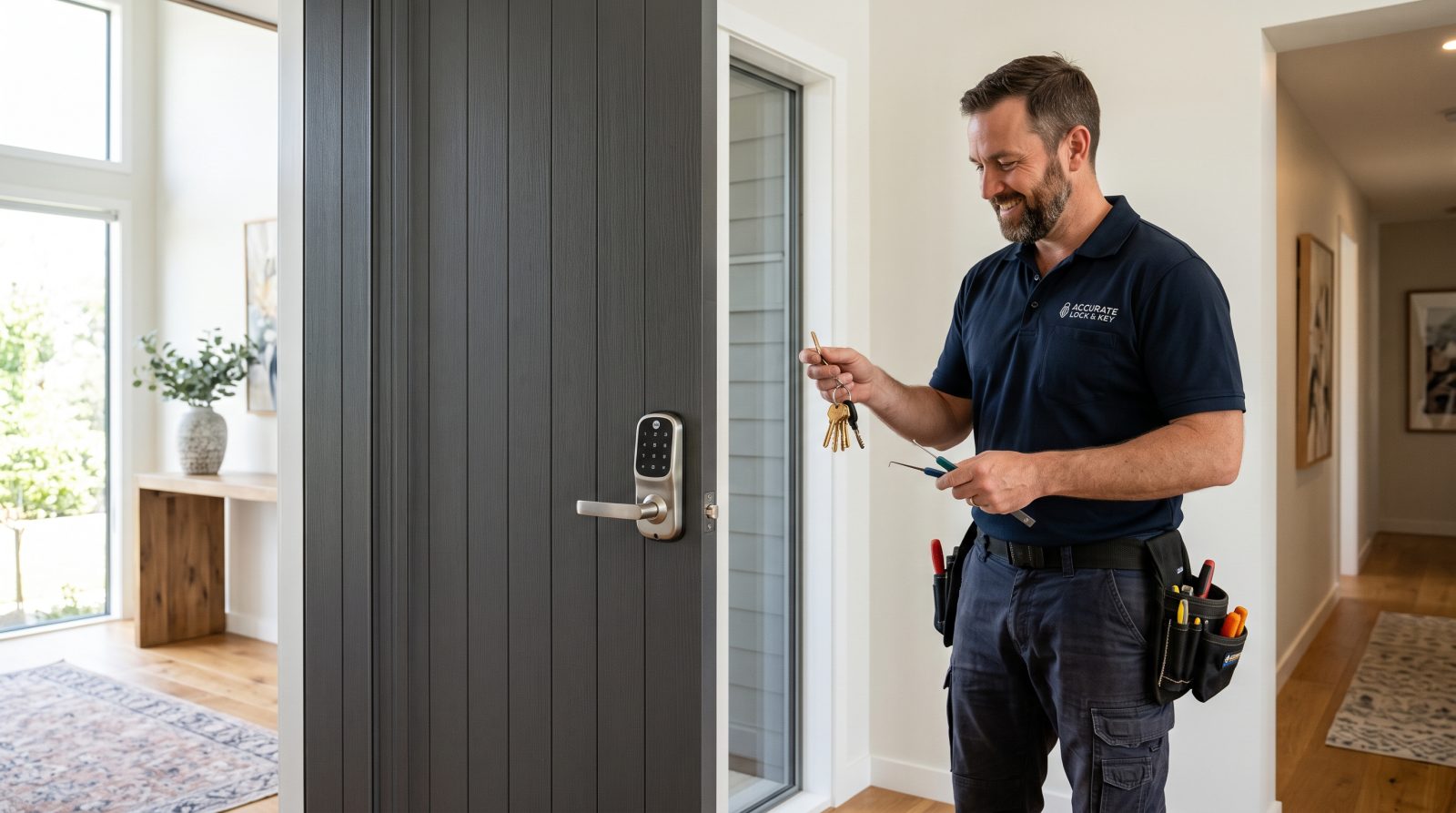
What is a typical lockout service cost?
For a standard lockout where a locksmith helps you regain entry to a home, car, or business, the all-in price usually lands in the $75 to $250 range across the industry. Simpler jobs, like a basic residential door during normal business hours, tend to sit toward the lower end, while jobs that involve high-security locks, after-hours timing, or longer travel push toward the higher end.
It helps to understand how that total is built. Most locksmiths quote a price made up of two parts: a service call or trip fee to send a technician to you, and a labor charge for the actual work of opening the lock or making a key. Some companies fold these together into one flat price, while others itemize them. Either way, a reputable locksmith should be willing to give you a clear price range before they start.
These figures are typical industry estimates, not a binding quote. Your real cost depends on the specifics of your lock, your location, and the time of day, all of which are covered below. When in doubt, ask for the total price up front, including any fees, so there are no surprises.
- Service/trip fee: often $35 to $100, sometimes credited toward the job
- Labor for a standard lockout: often $50 to $150 on top of the trip fee
- Typical all-in residential or car lockout: roughly $75 to $250
- All figures are estimated industry ranges, not quotes
What affects the price of a lockout service?
No two lockouts are priced exactly alike because several real factors move the number up or down. Knowing them helps you understand a quote and avoid feeling overcharged.
The biggest drivers are the type of lock, the time of day, the distance the locksmith travels, and how complicated the entry is. A standard residential deadbolt during the day is straightforward. A high-security commercial lock, a vehicle with an electronic key system, or a late-night call in a remote area all add cost. Special situations, such as a lock that has been damaged or a key broken off inside, can also require extra labor or parts.
- Lock type: standard residential, high-security, automotive, or commercial
- Time of day: after-hours, weekend, or holiday calls commonly cost more
- Travel distance: jobs far from the locksmith may carry a higher trip fee
- Complexity: damaged locks, broken keys, or electronic systems add labor
- Parts: rekeying, a replacement cylinder, or a new key blank may add cost
- Vehicle factors: car make, model, and key technology change the work involved
How much does a car lockout cost vs. a house lockout?
Home and car lockouts are priced a little differently because the work involved is different. A house or apartment lockout is usually about getting past a residential lock without damage, while a car lockout depends heavily on the vehicle and its key system.
For a home lockout, the typical industry range is around $75 to $200 for a standard door during normal hours, with high-security locks or after-hours calls landing higher. A car lockout often falls in a similar $75 to $200 range to simply unlock the door, but if you have also lost the key, programming or replacing a transponder or smart key is a separate job that can cost significantly more because of the parts and equipment involved.
Business and commercial lockouts can run higher again, because commercial doors, panic hardware, and master-key systems are more complex. The right way to compare is to tell the locksmith exactly what you are locked out of, since a lockout covers everything from a simple bedroom door to a storefront with a high-security system.
- House/apartment lockout: typically about $75 to $200 for a standard door
- Car lockout (unlock only): typically about $75 to $200, varies by vehicle
- Lost car key (program/replace): a separate, often higher cost due to parts
- Commercial/business lockout: often higher due to complex hardware
What does a lockout service call actually involve?
Understanding what you are paying for makes the price easier to judge. A typical lockout call follows a predictable set of steps, and a trustworthy locksmith will walk you through them.
First, the locksmith confirms the situation over the phone and gives you a price range. On arrival, a professional should verify that you are authorized to access the property or vehicle, which usually means showing identification or proof you live there or own the car. This is a normal, expected step that protects everyone. The technician then assesses the lock and chooses the appropriate method to regain entry with as little risk to the lock as possible. Once you are back in, you settle the agreed price.
In many home and car lockouts, the goal is non-destructive entry, meaning the lock is opened without being damaged. In some cases, a lock may need to be rekeyed or replaced afterward, which is a separate service with its own cost. For security reasons, reputable locksmiths do not publish or explain methods for defeating locks; the focus here is on what to expect as a customer, not how the work is performed.
- Phone confirmation and an up-front price range
- Identity or ownership verification on arrival, a normal safeguard
- Assessment of the lock and the appropriate entry approach
- Regained entry, then payment of the agreed amount
- Optional follow-up work such as rekeying or replacement, priced separately
Rekey vs. replace: when a lockout turns into extra cost
Sometimes a lockout reveals a deeper issue, such as a worn, damaged, or compromised lock, and you may decide to rekey or replace it. These are different jobs with different costs, so it is worth knowing the distinction.
Rekeying changes the internal pins of an existing lock so old keys no longer work and a new key does, all without replacing the hardware. It is generally the more economical option when the lock itself is in good shape, and it is common after a lost key or a move. Replacing the lock means installing a new physical lock or cylinder, which costs more because of the hardware but makes sense when a lock is broken, badly worn, or you want to upgrade security.
If you only need to get back inside, you may not need either service. But if the locksmith finds a damaged lock, ask whether rekeying or replacement is the better value for your situation, and request the added cost in writing before approving the work.
- Rekey: reuses existing hardware, changes the working key, usually lower cost
- Replace: installs new hardware, higher cost, better for broken or upgraded locks
- Neither is required just to end a lockout if the lock is healthy
- Always get the added price confirmed before extra work begins
How to avoid overpaying and get a fair lockout price
The clearest way to protect yourself is to get the full price before any work starts. A fair, professional locksmith will explain the service fee, the expected labor, and any likely add-ons, and will not pressure you into extras you do not need.
Be cautious of a quote that sounds suspiciously low on the phone but balloons on arrival, or of vague answers when you ask for a total. Ask specific questions: Is the trip fee included or separate? Does the price change for after-hours work? Will entry be attempted without damaging the lock? Getting answers in advance keeps the final bill predictable.
Because pricing depends so heavily on your exact lock, location, and timing, the most accurate number always comes from describing your situation and requesting a quote. We do not publish fixed prices, because a fair estimate has to reflect the real job in front of you, but we are happy to give you a clear, free quote before you commit.
- Ask for the all-in price, including the trip fee, before work begins
- Confirm whether after-hours or weekend rates apply to your call
- Ask whether non-destructive entry is expected for your lock
- Get any add-ons, like rekeying, priced and approved in advance
- Request a free quote for your specific situation rather than relying on averages