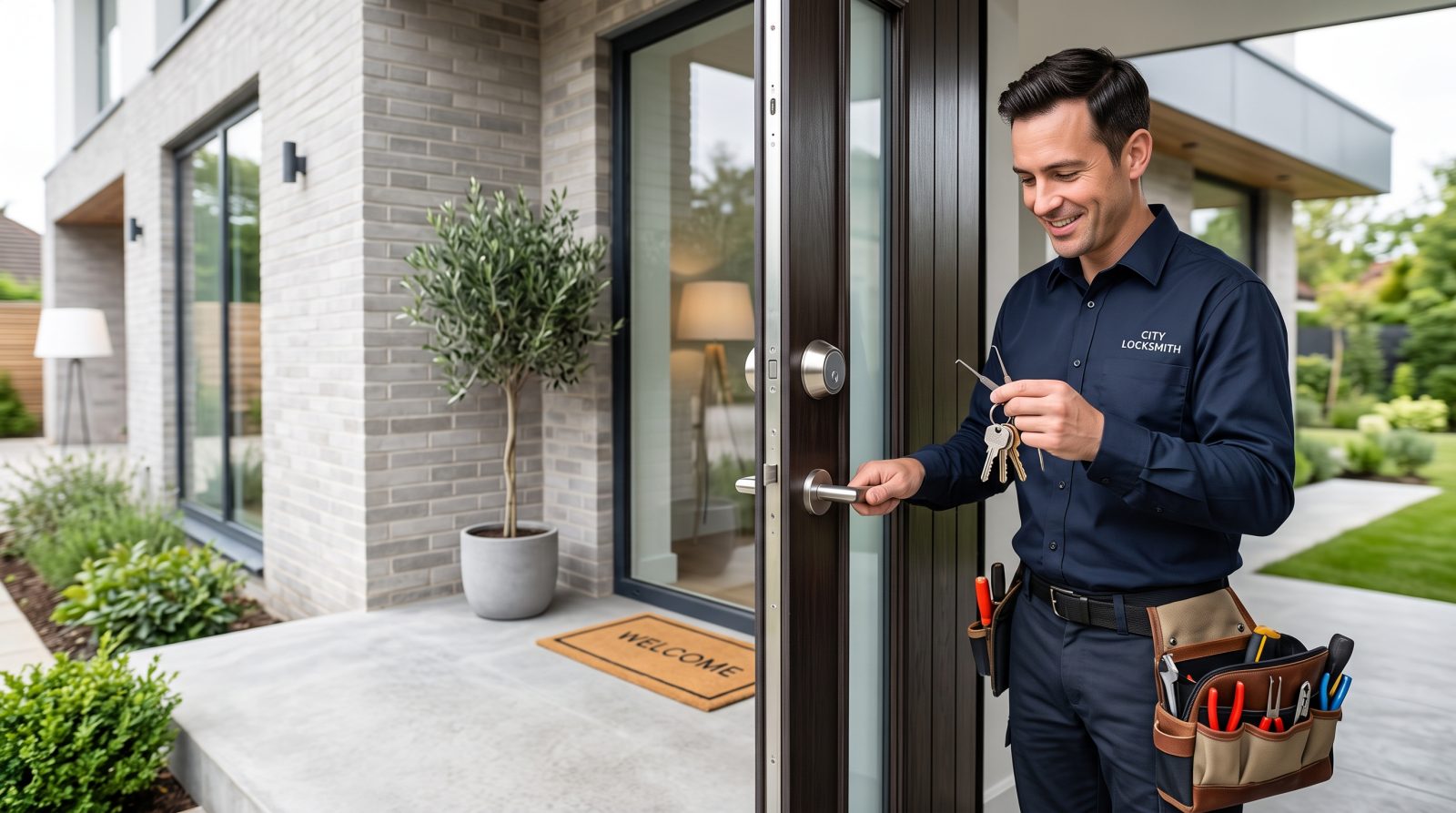
What makes a deadbolt 'good'?
A deadbolt is 'good' when its grade, materials, and installation all hold up under real-world force. Unlike a spring latch on a door handle, a deadbolt has no spring — once thrown, the bolt stays extended until you deliberately retract it with a key or thumbturn, which is why it resists pushing and prying far better than a knob lock alone.
The single biggest quality signal is the bolt itself. Look for a deadbolt with a one-inch throw, meaning the bolt extends a full inch into the door frame when locked. A longer, hardened steel bolt seats deeper into the strike and the framing behind it, so the connection between door and wall is harder to force.
Materials matter beyond the bolt. Good deadbolts use solid metal cylinders and housings rather than thin pot-metal, include a strike plate (the metal plate on the frame the bolt enters), and come with anti-pick or anti-bump cylinder features on higher-end models. None of these replace a proper installation — even the best lock underperforms in a weak frame.
- One-inch throw bolt made of hardened steel
- Solid metal cylinder and housing, not thin cast metal
- Reinforced strike plate with long screws that reach the wall stud
- An ANSI/BHMA grade stamped or listed on the packaging
- A cylinder format (keyed, keypad, or smart) that matches how you actually use the door
What do ANSI/BHMA deadbolt grades mean?
Residential and commercial locks in the United States are commonly rated by ANSI/BHMA (American National Standards Institute / Builders Hardware Manufacturers Association) into Grade 1, Grade 2, and Grade 3. The grade reflects how the lock performed in standardized lab tests for things like operational cycles and resistance to applied force — it is a useful, citable benchmark, not a guarantee about any specific door.
Grade 1 is the highest residential/commercial tier and is designed to withstand the most cycles and force; it's a common choice for exterior doors where you want maximum strength. Grade 2 is a strong residential choice that balances durability and cost. Grade 3 meets a basic residential level and is generally better suited to lower-risk interior or secondary applications than to a main entry door.
When comparing two deadbolts, the grade is one of the clearest apples-to-apples specs you can check. Pair the grade with the throw length and strike-plate quality, and you have a solid picture of the lock's mechanical strength before you ever look at brand or finish.
- Grade 1 — highest tier; strong fit for main exterior entry doors
- Grade 2 — durable residential option balancing strength and price
- Grade 3 — basic residential level; better for lower-risk or secondary doors
- The grade is usually printed on the package or in the spec sheet — check it before buying
Should you choose single-cylinder or double-cylinder?
Deadbolts come in three common interior configurations. A single-cylinder deadbolt has a key cylinder on the outside and a thumbturn on the inside, so you can lock or unlock from inside by hand. A double-cylinder deadbolt has a key cylinder on both sides, requiring a key to operate from inside as well. A keyless or thumbturn-only model is used where there's no outside keyway, such as some patio or interior doors.
Single-cylinder is the most common choice for typical entry doors because the inside thumbturn lets you exit quickly. Double-cylinder deadbolts are sometimes considered for doors with glass nearby, on the theory that a broken pane shouldn't give easy access to a thumbturn — but they introduce a real safety trade-off, because you need a key to get out from the inside in an emergency.
Because of that egress concern, many local fire and building codes restrict or prohibit double-cylinder deadbolts on certain doors, and requirements vary by jurisdiction. If you're weighing a double-cylinder lock, confirm what your local code allows first. A keyed door you can't open from inside without a key is a serious fire-escape risk for any household.
For doors with glass, alternatives such as laminated or reinforced glass, a single-cylinder deadbolt set back from the glass, or a captive-thumbturn design can address the concern without locking people inside. A locksmith can walk you through the options for your specific door.
Keyed, keypad, or smart deadbolt: which is right for you?
Beyond the cylinder configuration, deadbolts differ in how you unlock them. A traditional keyed deadbolt is simple, has no batteries, and is easy to service. A keypad (electronic) deadbolt replaces or supplements the key with a code, which is handy for households that hate carrying keys or want to give out a temporary code. A smart deadbolt adds connectivity — app control, remote locking, and activity logs — usually over Wi-Fi, Bluetooth, Z-Wave, or Zigbee.
Smart-home compatibility is worth checking before you buy. Many smart locks now support the Matter standard or work within ecosystems like Apple Home, Google Home, or Amazon Alexa, so confirm the lock speaks the protocol your other devices use. A lock that pairs cleanly with your hub is far less frustrating than one bolted on as an afterthought.
Whatever the electronics, the underlying mechanics still matter. A smart deadbolt is only as secure as its bolt, strike, and grade — so apply the same throw-length, materials, and ANSI/BHMA-grade checks to a connected lock that you would to a plain keyed one. Convenience features sit on top of good hardware; they don't substitute for it.
Practical considerations round out the decision: battery type and expected life on electronic models, whether there's a mechanical key override, how codes or app access are managed when guests or service people need entry, and whether the finish and backset match your door.
- Keyed — simplest and battery-free; easy to rekey and service
- Keypad — code entry, good for keyless convenience and temporary access
- Smart — app/remote control and logs; check Matter or ecosystem compatibility
- On any electronic lock, confirm a mechanical key backup and battery type
How do you make sure a deadbolt fits your door?
Even a top-grade deadbolt fails its job if it doesn't fit the door. The two key measurements are the backset — the distance from the door's edge to the center of the bore hole, commonly 2-3/8 inches or 2-3/4 inches in U.S. residential doors — and the door's thickness, since most deadbolts are built for a standard range and need an adjustment kit outside it. Measure both before you buy.
Door material affects both the lock choice and the installation. A solid wood or fiberglass door with a sturdy frame gives the bolt something strong to seat into; a hollow or thin door, or a frame with a worn jamb, undercuts even a great lock. On metal doors, you'll want hardware rated for that material and the correct prep.
The strike side is where many DIY installs fall short. Replacing the short screws that ship with many strike plates with longer 3-inch screws that bite into the wall framing behind the jamb meaningfully strengthens the door against forced entry, and a reinforced strike plate or box strike adds more. This is one of the highest-value, lowest-cost upgrades you can make.
If you're matching a new deadbolt to an existing handle, consider keying them alike so one key works both, and confirm finishes and styles line up. A professional install ensures the bore alignment, bolt-to-strike fit, and frame reinforcement are all correct — the details that determine whether the lock actually performs.
- Measure the backset (commonly 2-3/8" or 2-3/4") and door thickness first
- Match hardware to your door material (wood, fiberglass, or metal)
- Upgrade to 3-inch strike-plate screws that reach the wall framing
- Consider keying the deadbolt and handle alike for a single key
What does a deadbolt cost, and is professional installation worth it?
The figures below are typical industry ranges for general planning — they are estimates, not quotes, and your actual price depends on the lock you choose, your door and frame, your location, and current market conditions. For an accurate number, request a free quote for your specific door.
As a rough planning guide, a basic keyed residential deadbolt often falls in the lower tens of dollars, mid-range Grade 1 or Grade 2 locks in roughly the $40-$150 range, and keypad or smart deadbolts commonly from around $100 into the several-hundred-dollar range depending on features. Professional installation is typically billed as a service fee plus any parts, and it's where reinforcement and correct alignment get done right.
Professional installation tends to be worth it when the door isn't already bored for a deadbolt, the frame or jamb needs reinforcement, you're fitting a metal door, or you're installing a smart lock you want integrated cleanly. The lock's grade only pays off when the bolt, strike, and frame work together — and that's the part a skilled installer gets right.
If you're unsure which grade or format fits your situation, you don't have to guess. Tell us about your door and what you're trying to protect, and we'll help you choose and install the right deadbolt.
- Basic keyed deadbolt: lower tens of dollars (estimate)
- Mid-range Grade 1/Grade 2: roughly $40-$150 (estimate)
- Keypad/smart deadbolt: roughly $100 to several hundred dollars (estimate)
- Installation: a service fee plus parts; varies by door and location (estimate)