What does car key replacement actually involve?
Replacing a car key is usually a two-part job: making a key that fits the lock and ignition, and setting up the electronics so the vehicle accepts it. On older vehicles, cutting may be all you need. On most cars built in the last two decades, the second step — programming a chip or key fob to the car's anti-theft system — is what lets the key start the engine.
An automotive locksmith identifies your key type, cuts a new blank to match your lock, and then pairs the new key's transponder chip with the car. For push-to-start vehicles, the same idea applies to the proximity fob the car senses nearby.
If you have lost every working key, the job takes more work than making a spare. There is no existing key to copy, so the locksmith must originate a key from the vehicle itself. Having a spare key, your VIN, and proof of ownership on hand helps the job go more smoothly.
Types of car keys and fobs a locksmith can replace
Vehicles use several key types, and the right replacement depends on what your car was built to use. Knowing your type helps set clear expectations for time and cost.
- Basic mechanical key — a plain cut metal key with no chip, common on older vehicles. It is the simplest and least expensive to replace.
- Transponder (chip) key — a metal key with an embedded chip that must be paired to the car before the engine will start. This is the core of transponder key replacement.
- Remote head key — a one-piece key that combines the cut blade and the remote lock and unlock buttons in the head of the key.
- Flip / switchblade key — a key whose blade folds into the fob and springs out at the press of a button. The blade is cut and the chip is programmed.
- Smart key / proximity fob — used on push-to-start vehicles. The car detects the fob nearby, so there may be no traditional blade except a hidden emergency key.
- Emergency / valet key — the thin backup blade tucked inside many fobs, used to open a door by hand if the fob battery dies.
Lost all your keys vs. needing a spare
There is a real difference between making a spare and replacing a key when none work. If you still have a working key, an automotive locksmith can often make an extra one quickly by copying the cut and cloning or programming another chip.
When all keys are lost, the locksmith has to determine the right cut from the vehicle and create a brand-new key, then program it to the car. This usually takes longer and may need extra steps to re-pair the system, depending on the make and model.
Because a lost-all-keys job also raises a security issue, expect to show that the car is yours. A reputable locksmith will ask for ID and proof of ownership before making keys for a vehicle — that protects you as much as it protects them.
What affects the cost of car key replacement?
There is no single price for a car key, because each job is different. The figures here are planning ranges, not fixed quotes. For accurate pricing, request a free quote with your year, make, and model.
As a rough guide, a basic non-chip mechanical key is usually the least expensive. Transponder and remote keys sit in the middle. Smart and proximity fobs for newer vehicles are usually the most expensive because the fob hardware and programming take more work. Luxury, late-model, and some imported vehicles can cost more still.
- Key type — a plain metal key is far cheaper than a programmed smart fob.
- Vehicle make, model, and year — newer and luxury vehicles often use pricier fobs and more complex programming.
- Whether you have a working spare — making an extra key is usually simpler than starting from zero when all keys are lost.
- Fob hardware cost — the remote or fob itself is a real parts cost, separate from labor.
- Programming complexity — some systems take more time or special tools to pair.
- Location and timing — a mobile, on-site visit may be priced differently from a shop visit.
What to have ready before you call
A little prep makes car key replacement faster and helps the quote come back more accurate. The main details show which key your car needs, and the documents prove the vehicle is yours.
Getting these ready also cuts down on back and forth. It helps the locksmith bring the right key blank and fob the first time, especially for a lost-all-keys job, where there is nothing to copy.
- Year, make, and model of the vehicle — trim can matter too.
- Your VIN — usually visible through the windshield on the driver's side or on the driver's door jamb.
- Proof of ownership and a photo ID — a reputable locksmith will ask to see them.
- Whether you still have any working key — or have lost all of them.
- The exact location of the vehicle — if you want mobile, on-site service.
How a mobile car key replacement visit typically works
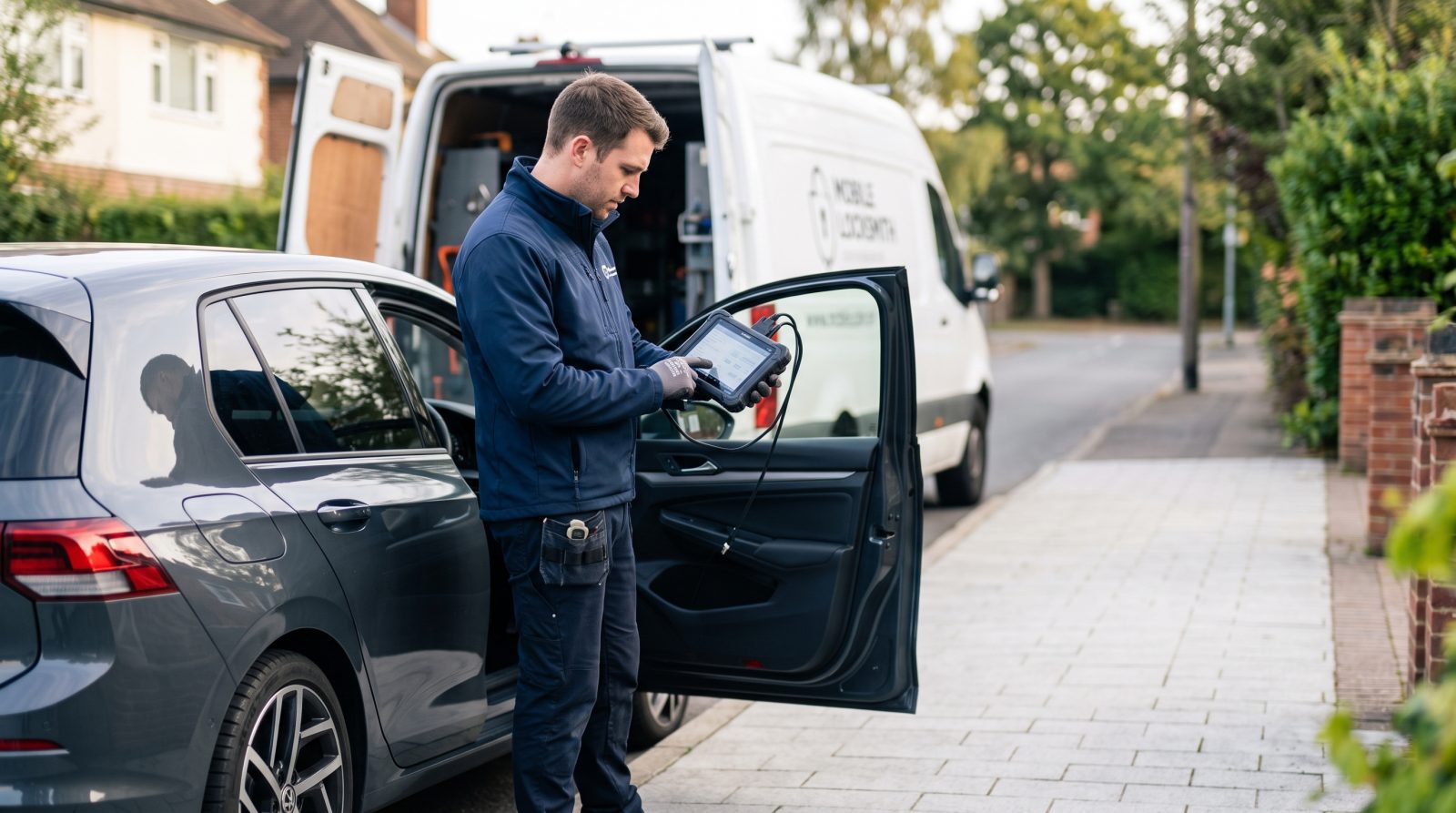
Many car key jobs can be handled where your vehicle is parked, which helps when the car is not drivable without a key. After you describe your vehicle and key type and confirm the work, a locksmith comes to your location.
On arrival, the locksmith checks ownership, confirms the key type, cuts the new blade if your key has one, and programs the transponder or fob to your car's system. Before leaving, the new key is tested in the lock and ignition, or by starting a push-to-start vehicle, so you can confirm it works.
Timing depends on the vehicle and whether a spare exists. A simple spare can be quick. Creating keys for a lost-all-keys job on a newer vehicle takes longer. The goal of any honest visit is a working key and a clear explanation of what was done.
Ignition Repair & Replacement
Key won't turn, or is the ignition worn or damaged? Our mobile auto locksmith handles ignition repair and replacement at your location, along with car locksmith services like lockouts and key cutting. Call (877) 300-2747.