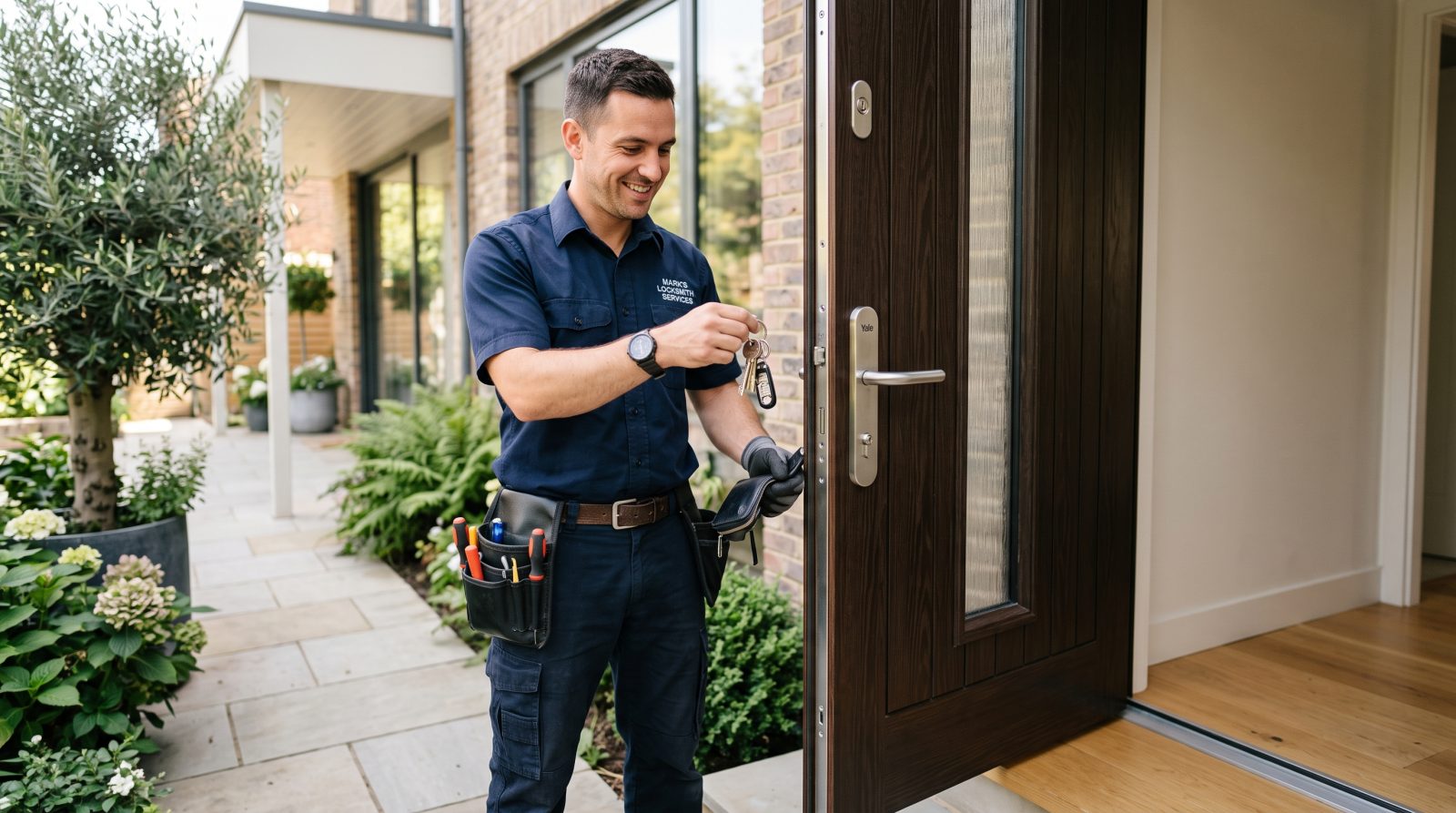
How door locks are categorized
Door locks are grouped two ways: by the mechanism that throws the bolt and by how you operate it. Understanding both makes the rest of this guide easier to follow, because most products are simply a combination of a mechanism and an operating method.
By mechanism, most residential and commercial locks use a pin-tumbler cylinder. Inside the cylinder, spring-loaded pins of varying heights must line up at a precise boundary (the shear line) before the plug can turn. The correct key raises each pin to the right height; the wrong key leaves pins blocking the turn. This is also why a lock can be rekeyed: a locksmith swaps the pin heights so a new key pattern works and the old key no longer does, without replacing the whole lock.
By operation, locks are mechanical (a physical key or thumbturn), keyless mechanical (a dial or push-button code), or electronic (a keypad, fob, card, or phone). Many doors mix categories, for example an electronic deadbolt that still accepts a physical key as a backup.
- Bolt type: deadbolt (no spring, must be turned) vs. spring latch (the angled bolt on knobs and levers)
- Cylinder type: pin-tumbler is most common; high-security cylinders add extra pins or sidebars
- Operation: keyed, thumbturn, code, or electronic credential
- Grade: hardware is often rated for durability and security, with commercial-grade typically being the most robust
Deadbolts: a common choice for exterior doors
A deadbolt is a mainstay of front, back, and side doors. Unlike a spring latch, a deadbolt has no spring, so the bolt cannot be pushed back without turning the key or thumbturn. That solid throw into the door frame is why many people rely on it as the primary lock for entry doors.
There are three common configurations. A single-cylinder deadbolt uses a key on the outside and a thumbturn on the inside, and it is the most widely installed option. A double-cylinder deadbolt requires a key on both sides, which can deter entry through a nearby window but can slow exit in an emergency, so it should be chosen carefully and in line with local fire and building codes. A keyless or electronic deadbolt replaces the outside key with a keypad or phone credential.
Deadbolt strength depends heavily on installation. A bolt that throws a full inch into a reinforced strike plate anchored with long screws into the frame stud tends to resist force better than one with a short throw and short screws. When a deadbolt is upgraded, the strike plate and screws are usually upgraded with it.
- Single-cylinder: key outside, thumbturn inside (most common)
- Double-cylinder: key on both sides (check fire and egress codes first)
- A longer bolt throw and a reinforced strike plate add meaningful resistance
- Often paired with a keyed knob or lever for everyday convenience
Knob and lever locks: convenience for everyday use
Knob locks and lever locks use a spring latch, the angled bolt that retracts when you turn the handle and snaps back when the door closes. This makes them convenient for constant daily use, which is why they are common on interior doors and as the secondary lock on entry doors alongside a deadbolt.
Because the latch is spring-loaded and the lock body often sits in the knob or lever itself, this style is generally not meant to be the main line of defense on an exterior door. The security value comes from pairing it with a deadbolt rather than relying on the handle lock alone.
Lever handles have a practical advantage over round knobs: they are easier to operate for people with limited grip strength and are frequently specified in commercial and accessibility-minded settings. Knobs remain popular indoors where simplicity and lower cost matter most.
- Spring latch retracts with the handle and self-latches when the door shuts
- Best as a secondary lock on entry doors, or a primary lock on interior doors
- Levers are easier to grip than knobs and common in commercial settings
- Privacy and passage versions exist for bedrooms, bathrooms, and closets
Mortise, cylinder, and high-security locks
Mortise locks are heavy-duty locks set into a pocket (a mortise) cut into the edge of the door, rather than mounted through a bored hole. They combine a latch and a deadbolt in one robust body and are common on older homes, apartment buildings, and commercial entrances because of their durability and longevity. Replacing or servicing a mortise lock is more involved than swapping a standard bored lock, so it is often a job worth having handled professionally.
Cylindrical locks are the through-the-door style most modern homes use, where the lock fits into round holes bored in the door face and edge. They are easier to install and service, which contributes to their popularity.
High-security locks build on the pin-tumbler concept with added features that make keys harder to copy and the cylinder harder to manipulate, such as additional pin rows, sidebars, and patented keyways that restrict where blank keys can be obtained. They typically cost more and are chosen when controlling key duplication and resisting tampering are priorities. For honest expectations: no lock is impossible to defeat, but higher-grade hardware raises the time, skill, and effort required.
- Mortise: durable, fits a pocket in the door edge, common in older and commercial buildings
- Cylindrical (bored): the standard easy-to-install style in most modern homes
- High-security: restricted keyways and extra mechanisms limit copying and tampering
- Hardware grading helps compare durability across products
Electronic and smart locks: keypads, fobs, and app control
Electronic locks replace or supplement a physical key with a code, card, fob, or smartphone. Keypad locks use a numeric code, which is handy for households, rentals, and anyone who would rather not carry keys. Smart locks add connectivity so you can lock or unlock remotely, issue temporary codes for guests or service visits, and see a log of when the door was used.
Connectivity varies by model. Some smart locks use Wi-Fi for direct internet access, some use Bluetooth for short-range phone control, and many newer devices support Matter, an industry standard designed to help smart-home products from different brands work together. Z-Wave and Zigbee are other common protocols that connect through a hub. Choosing a lock that fits your existing smart-home setup helps avoid compatibility headaches.
Two practical notes. First, most reputable electronic deadbolts include a mechanical key override or a backup power option (such as exterior battery terminals) so a dead battery does not lock you out. Second, an electronic lock is only as strong as the deadbolt mechanism behind it, so the same fundamentals (solid bolt, reinforced strike, sound installation) still apply.
- Keypad: enter a code instead of using a key, with codes you can change
- Smart: remote control, temporary guest codes, and access history via an app
- Standards to know: Matter, Wi-Fi, Bluetooth, Z-Wave, and Zigbee
- Look for a mechanical key override or backup power for dead-battery situations
Padlocks, cam locks, and specialty hardware
Not every lock guards a main door. Padlocks are portable locks with a shackle, used on gates, sheds, lockers, and storage units. They come in keyed and combination versions, and shackle thickness, body material, and whether the shackle is shrouded all affect how much resistance they offer.
Cam locks are small rotating locks found on cabinets, mailboxes, display cases, and some equipment. Turning the key rotates a flat metal cam that catches behind a frame to hold a small door or drawer shut. They are about controlling casual access rather than securing a building entrance.
Other specialty hardware includes deadlatches (a spring latch with an anti-shim feature common on commercial glass doors), interconnected locks that retract both the latch and deadbolt with a single motion for faster egress, and gate or fence locks built to handle outdoor exposure. The right specialty lock depends entirely on what it is protecting and how often it is used.
- Padlocks: portable; thicker and shrouded shackles tend to resist cutting better
- Cam locks: cabinets, mailboxes, and drawers, for casual access control
- Deadlatches and interconnected locks: common on commercial and code-driven doors
- Match the hardware to the door, environment, and how often it is used
How to choose the right lock for your door
Start with the door and its role. Exterior entry doors generally call for a deadbolt as the primary lock, ideally paired with a keyed knob or lever for daily convenience. Interior doors usually need only a knob or lever, with privacy versions for bathrooms and bedrooms. Gates, sheds, and cabinets point you toward padlocks or cam locks instead.
Then weigh how you want to get in. If carrying keys is a hassle, or you frequently grant access to family, guests, or service providers, a keypad or smart lock may be worth the higher cost. If simplicity and a lower price are the priority, a quality mechanical deadbolt is hard to beat. Either way, controlling who has keys or codes matters as much as the lock itself, which is why rekeying is a common first step after moving into a new home.
Finally, think about installation. Swapping a standard bored deadbolt is straightforward, but mortise locks, double-cylinder setups, high-security cylinders, and integrating smart locks with an existing system are areas where professional installation helps you avoid alignment, code, and compatibility problems. If you are unsure which combination fits your doors, request a free quote for guidance specific to your situation.
- Exterior doors: deadbolt as primary, knob or lever as secondary
- Interior doors: knob or lever, with privacy function where needed
- Keyless living: keypad or smart lock if convenient access is a priority
- New home or lost keys: rekeying resets who can get in
- Complex jobs: mortise, double-cylinder, and high-security work suit professional installation