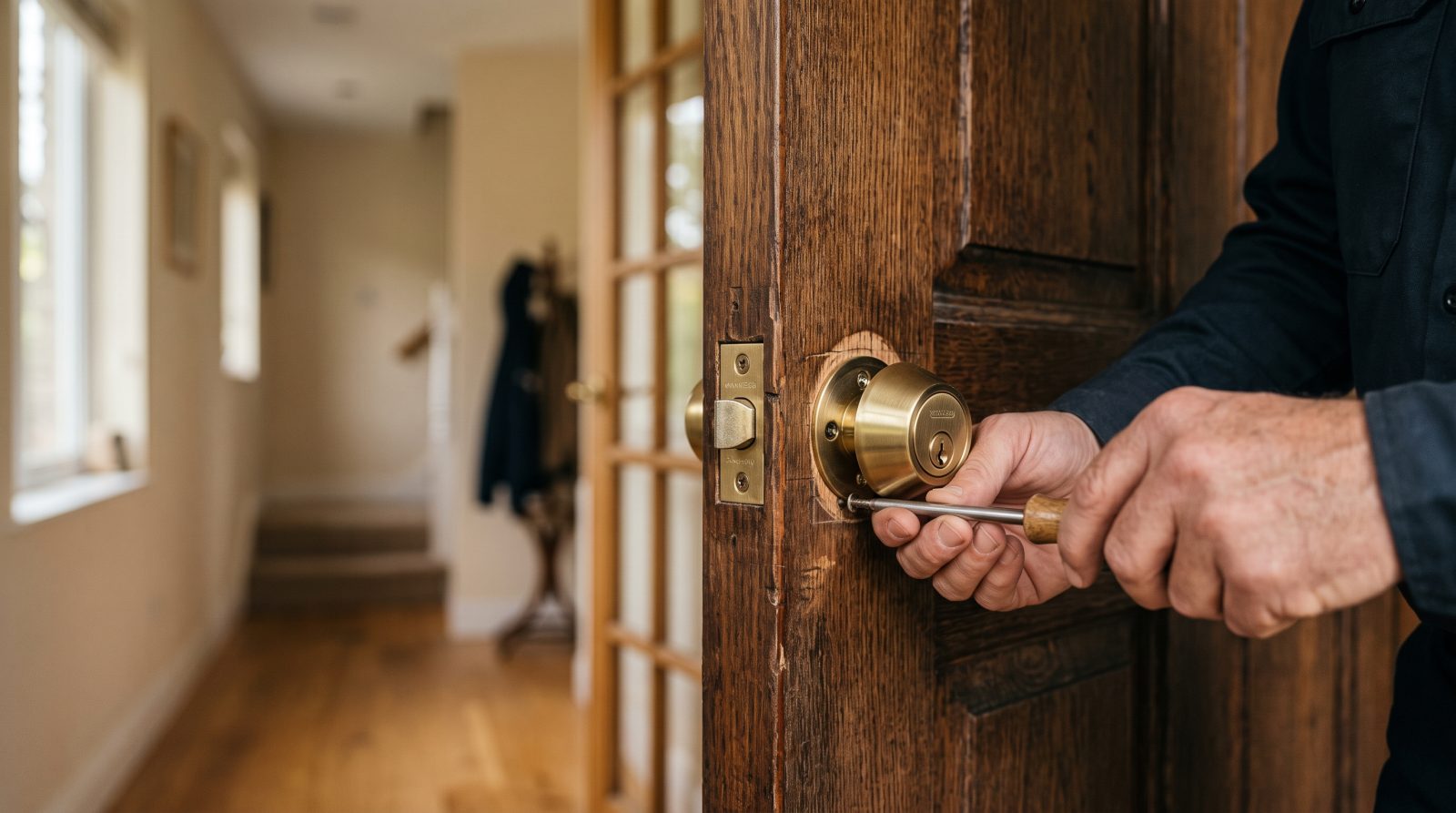
What does deadbolt installation involve?
A deadbolt is a bolt that moves only when you turn the key or thumbturn, unlike a spring latch that can be pushed back. Because the bolt has no spring, it resists being forced back from the edge of the door, which is why a properly installed deadbolt is one of the most common entry-door upgrades homeowners and businesses ask for.
A typical installation starts with the locksmith confirming the door thickness, the backset (the distance from the door edge to the center of the lock hole), and whether the door already has a bore hole. If a new deadbolt is going into a door with no existing hole, the locksmith uses a hole saw and chisel to cut the cross bore, edge bore, and mortise for the strike plate. The bolt assembly goes into the door edge, the cylinder and thumbturn mount on each face, and the strike plate is fastened into the door jamb.
Before finishing, the locksmith checks that the bolt throws its full length, that it lines up with the strike plate without binding, and that the screws seat into the framing. A deadbolt that does not throw completely or that catches on the strike is a common point of failure, so this alignment step matters as much as the cut.
- Measure door thickness, backset, and existing bore (if any)
- Bore the cross hole and edge hole if the door is undrilled
- Mortise and install the strike plate in the jamb
- Confirm full bolt throw and clean alignment before sign-off
Types of deadbolts and which one fits your door
Deadbolts come in several configurations, and the right one depends on whether your door has nearby glass, how you want to lock from the inside, and whether you want app or keypad control. A locksmith can walk you through the trade-offs for your specific door.
Single-cylinder deadbolts are the most common: a key operates the lock from outside and a thumbturn operates it from inside. Double-cylinder deadbolts require a key on both sides, which is sometimes chosen for doors with glass panels nearby so a broken pane does not give access to a thumbturn. Double-cylinder locks carry a safety consideration during an emergency exit because they need a key to open from inside, and some local codes restrict them, so this is worth discussing before you choose.
Smart deadbolts add a keypad, app, or both, and many can still be operated by a physical key. Two industry standards you may see referenced are Z-Wave and Zigbee for hub-based home systems, along with Wi-Fi and Bluetooth models that connect directly to a phone. A locksmith can install a smart deadbolt and confirm the mechanical lock works correctly, though pairing it to your specific home network or smart-home platform may involve your device's own app.
- Single-cylinder: key outside, thumbturn inside (most common)
- Double-cylinder: key on both sides; consider emergency-exit and local code rules
- Smart deadbolt: keypad, app, or both, often with a physical key backup
- Smart standards you may see: Z-Wave, Zigbee, Wi-Fi, Bluetooth
Understanding deadbolt grades and door-hardening upgrades
Deadbolts are rated by ANSI/BHMA grades that reflect how they hold up to operational and security testing. Grade 1 is the highest tier and is common for commercial and high-traffic doors, Grade 2 is a strong residential choice, and Grade 3 is the basic residential level. The grade is usually printed on the packaging, and a locksmith can recommend a grade that matches how the door is used.
The lock is only part of the picture. Many forced-entry attempts fail at the door frame rather than the lock itself, so hardening the area around the bolt is often more valuable than the lock's grade alone. Common upgrades include a reinforced strike plate secured with longer screws that reach the wall stud, a strike box that captures the bolt, and door-edge or hinge reinforcement on doors that swing outward.
If you are upgrading security, it helps to think of the door as a system: the bolt, the strike, the frame, and the hinges all share the load. A locksmith can assess which part of that system is the weak point on your door and suggest the upgrade that gives you the most security for the work involved.
- Grade 1: highest tier, common for commercial and heavy-use doors
- Grade 2: strong residential option
- Grade 3: basic residential level
- Hardening adds value: reinforced strike plate, longer screws into the stud, strike box, hinge reinforcement
What deadbolt installation typically costs
The figures below are typical industry ranges to help you plan, not a quote. Actual pricing depends on the lock you choose, the condition of your door, whether new holes need to be bored, and your location. The only way to know what your job costs is to request a quote for your specific door.
As a general guide, a basic single-cylinder deadbolt installed in a door that already has a bore hole tends to sit at the lower end of the range, while smart deadbolts, double-cylinder locks, higher-grade hardware, or installations that require drilling an undrilled door fall higher. Hardening work such as a reinforced strike plate is often a modest add-on when done at the same time as the install.
Hardware cost is separate from labor when you supply your own lock versus having the locksmith provide it. Asking for an itemized estimate up front helps you compare options without surprises.
- Estimates only, not quotes; final price depends on lock, door condition, and location
- Lower end: basic deadbolt swapped into an existing bore hole
- Higher end: smart or double-cylinder locks, higher grades, or boring an undrilled door
- Reinforced strike plate is often a small add-on alongside the install
- Ask for an itemized estimate so labor and hardware are clear
Should you rekey, replace, or add a deadbolt?
These three jobs solve different problems, and knowing the difference helps you ask for the right service. Rekeying changes the internal pins of an existing lock so old keys stop working while you keep the same hardware; it is a good fit when keys are unaccounted for but the lock itself is fine. Replacement swaps the lock for new hardware, which makes sense when a lock is worn, damaged, or outdated. Adding a deadbolt installs a new lock where there was none, increasing the security of the door.
On an entry door, these are often combined. A new resident might add a deadbolt for security and rekey the existing knob lock so they match a single key. A locksmith can tell you whether your current lock is worth rekeying or whether a deadbolt addition plus frame hardening would do more for the same effort.
If your main concern is that someone may have a working key, rekeying or replacing the cylinder addresses that directly. If your concern is the strength of the door against forced entry, adding or upgrading a deadbolt and reinforcing the strike is the more relevant path.
- Rekey: keep the lock, change the pins so old keys stop working
- Replace: swap worn, damaged, or outdated hardware for new
- Add: install a deadbolt where there is none for more door security
- These are often combined and keyed alike on a single door
How to request deadbolt installation from a local locksmith
Because Locksmith Near Me connects you with local locksmiths, the most useful first step is to describe your door so you get an accurate estimate. Note the door type (wood, metal, or fiberglass), whether it is an exterior or interior door, and whether it already has a deadbolt hole. A photo of the door edge and the area around the existing lock helps a locksmith size the job quickly.
Mention any specific goals as well, such as wanting a smart deadbolt, keying multiple doors alike, or hardening the frame against forced entry. The more the locksmith knows up front, the closer the estimate will be to the final price. When you are ready, request a free quote and a local locksmith can confirm the hardware, scope, and what the work involves for your door.
- Note door material, interior vs exterior, and whether a deadbolt hole exists
- A photo of the door edge and lock area speeds up the estimate
- Mention goals: smart lock, keyed-alike doors, frame hardening
- Request a free quote to confirm hardware and scope